
So, you’ve had an idea for a product — or you’ve been handed the specification. The concept has been proven, prototyped and tested, and it’s ready to move into final design phases.
At this stage, decisions made on paper directly influence how efficiently and how successfully the product can be manufactured. For components that may ultimately be cast, those early design choices can significantly affect cost, performance and long-term reliability.
Below are eight important factors to consider as you refine your design.
1. Aesthetics
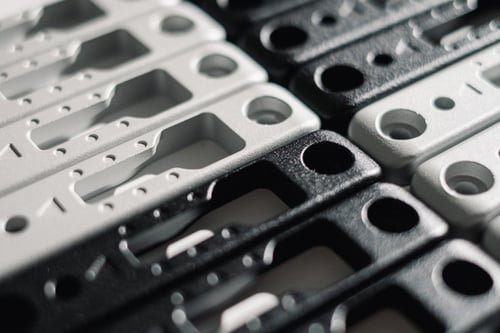
Aesthetics are often the most visible part of the design process. They’re the first thing customers, colleagues and stakeholders notice, long before they review performance data or technical specifications.
Good design should reflect the brand, market positioning and intended use of the product. Staying aware of design trends within your industry (and beyond) can help to ensure your product feels current without straying from its core identity. If Fiat’s new 500 suddenly looked like a Ferrari, it might turn heads; but it would also feel out of place and disconnected from its purpose.
When a product includes cast aluminium components (such as housings, enclosures or structural parts), surface finish, geometry and detailing all contribute to the perceived quality. Fortunately, casting offers flexibility in form, texture and finish – provided those considerations are built into the design from the outset.
That said, aesthetics should never override performance.
Nothing undermines confidence faster than a product where form has clearly been prioritised over function.
2. ERGONOMICS
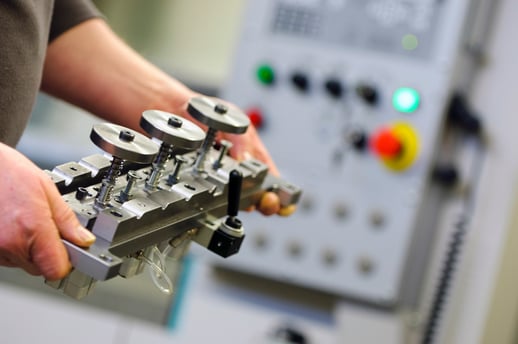
This is where function must lead.
Customers quickly forget about how attractive a product looks if it is awkward, uncomfortable or unintuitive to use. Ergonomics should be considered early, particularly where cast components form the outer structure or user interface of a product.
Wall thickness, edge radii, surface texture and weight all influence how a product feels in the hand. Casting processes allow these features to be integrated directly into the component geometry, rather than added later – but they must be designed intentionally.
If ergonomic improvements slightly compromise a purely aesthetic detail, that is often a worthwhile trade-off. A product that feels solid, balanced and comfortable will always outperform one that simply looks impressive.
3. MATERIALS
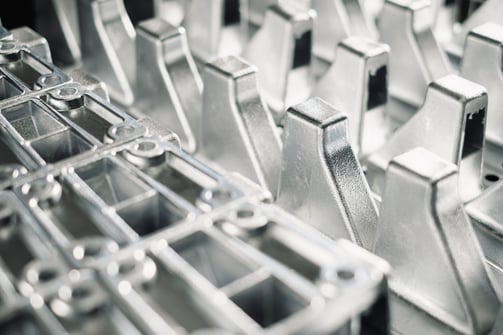
Material selection is one of the most critical decisions in modern product design. It directly affects manufacturability, durability and cost.
Understanding the product’s intended use, operating environment and expected lifecycle is essential. Temperature exposure, mechanical load, corrosion risk and regulatory requirements all play a role in determining whether a particular alloy or material grade is suitable.
When designing for aluminium casting, alloy choice will influence strength, corrosion resistance, thermal conductivity and machinability. The wrong selection can create unnecessary challenges later in production (or worse, in service).
Attention should also be paid to the full assembly, not just the primary component. Hardware specification matters from the outer housing down to screws, nuts and bolts. Incorrectly specified fasteners or mixed materials can shorten product life significantly.
For example, combining steel and aluminium without appropriate protection can lead to galvanic corrosion. Likewise, certain plastics and rubbers may degrade rapidly in oily or high-temperature environments.
Careful material research, including compatibility between materials, is essential before any component reaches the production line.
4. MANUFACTURE
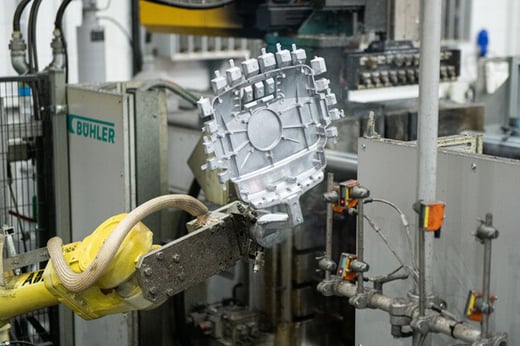
Modern manufacturing is extremely capable but every process has limits. CNC machining, for example, struggles with certain undercuts and internal features, while casting requires a careful design that allows clean removal from the mould.
It’s still possible to achieve a complex shape but this might involve splitting a component into smaller cast or machined sections for later assembly. Draft angles, parting lines and overhangs must be considered early in the design stage – which is exactly why designing with the chosen process in mind is so essential.
5. MODULARITY
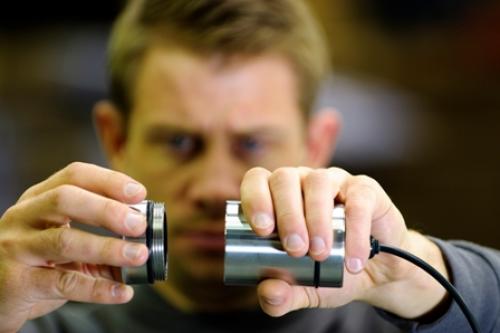
Dividing a product into smaller sections isn’t just a workaround for manufacturing constraints. In many industries, modular design is a deliberate, long-term strategy.
Automotive manufacturers are a clear example. Ford may produce a Focus with a standard engine configuration, while the performance-focused ST variant uses a more powerful engine within a largely shared architecture. This modular approach allows variation without requiring an entirely separate platform.
The same thinking can apply to cast components. Designing a core casting that supports multiple product variants can reduce tooling investment, simplify inventory and enhance future development.
Modularity also supports servicing and repair. If a single module can be replaced rather than an entire assembly, maintenance becomes more straightforward and cost-effective.
6. SUSTAINABILITY
Sustainability in product design involves more than just concern for the environment. It also includes long-term supply stability.
Material availability is a genuine commercial risk. There have been instances where businesses have struggled because a key material or component became scarce, restricted or commercially unviable. This applies not only to electronic parts but also to base materials.
When selecting alloys or other materials, it is important to consider supply resilience and the availability of suitable alternatives. Aluminium, for example, is easy to recycle and has well-established global supply chains, making it an attractive option from both environmental and strategic perspectives.
7. PROTECTION
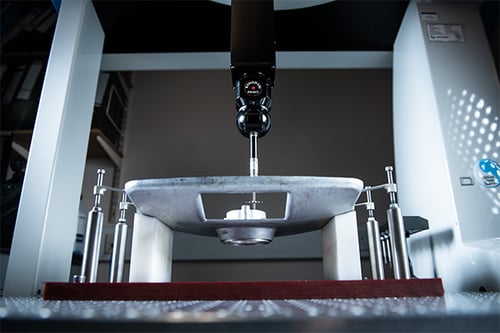
A product’s operating environment should always influence its design.
Industrial equipment is often required to meet specific Ingress Protection (IP) ratings to prevent failure due to water or dust ingress. Power tools must withstand airborne particles. Outdoor products may face prolonged exposure to moisture, UV light and fluctuating temperatures.
Where cast components are used as housings or structural elements, their design can play a direct role in environmental protection. Integrated sealing faces, gasket grooves and reinforced wall sections can be designed into the casting itself – improving durability and reducing reliance on additional parts.
Surface finishing also has its part to play. Corrosion-resistant coatings or treatments may be necessary to ensure long-term performance, particularly in marine or harsh industrial environments.
8. PACKAGING and ASSEMBLY
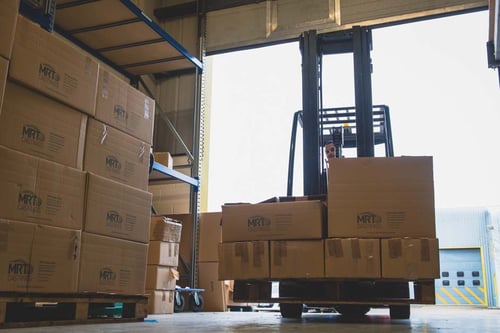
Packaging and assembly are often the first tangible interaction a customer has with a product.
The unboxing experience can communicate quality, utility or premium positioning before the product is even powered on. Equally, the ease (or difficulty) of assembly leaves a lasting impression.
From a manufacturing perspective, design decisions directly affect the ease of this first interaction. Cast components that integrate mounting features, alignment points or fastening locations can reduce assembly time and minimise error. Fewer separate parts often mean fewer opportunities for inconsistency, too.
From concept to completion, MRT Castings can help you to bring your product ideas to life.
By working with our team early in the design process, MRT can provide the advice you need to avoid regrettable design mistakes – as well as helping you to reduce the overall cost of machining, surface finishing and assembly.
MRT’s technical team has been designing successful cast components for decades. We work in partnership with your product designers to develop and adapt your concept, so it’s fully optimised for manufacture. By partnering with us, you can avoid common pitfalls and complete your project on time, within budget and ready for its final application.
Talk to us today to see how our expert team can support you.